







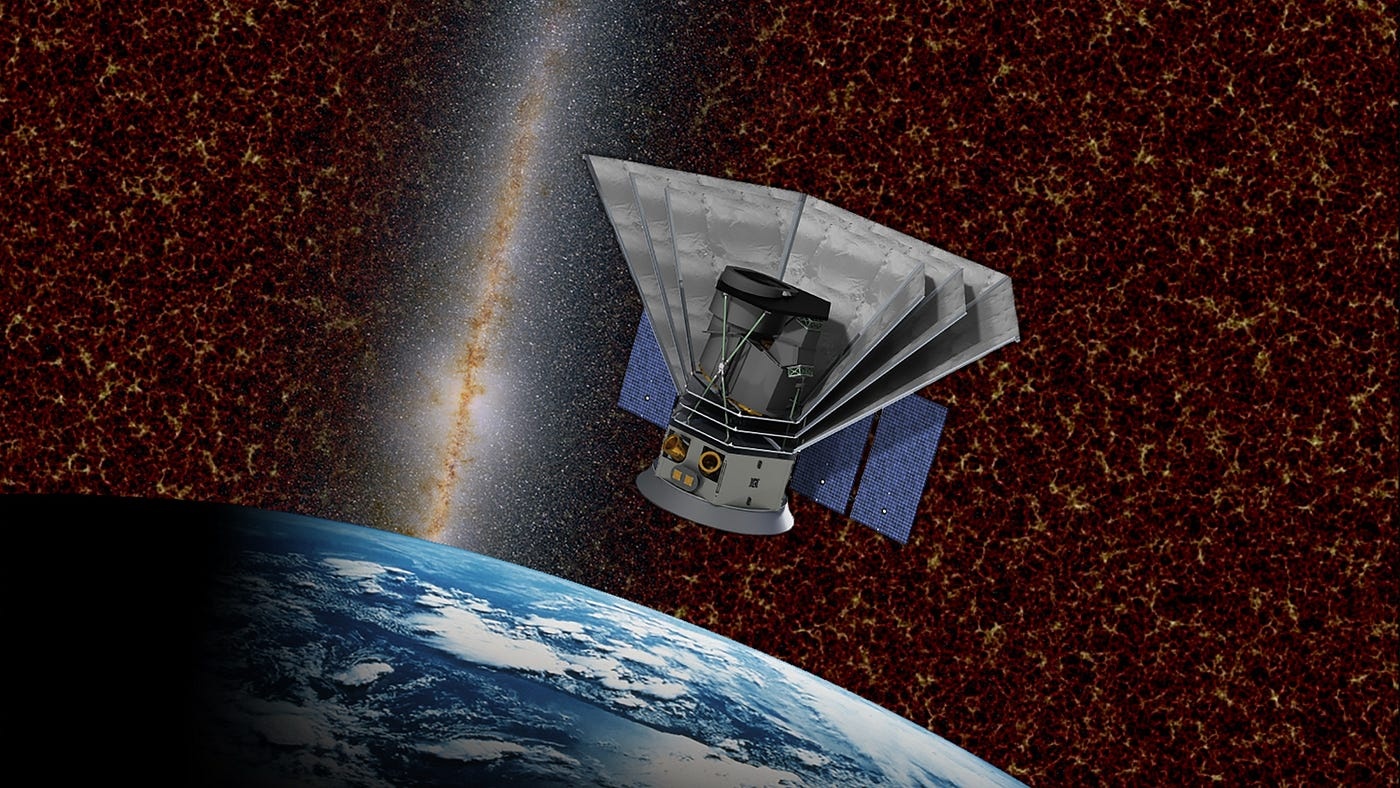
In March 2025, NASA launched SPHEREx (Spectro-Photometer for the History of the Universe, Epoch of Reionization and Ices Explorer), a groundbreaking space observatory designed to survey the sky in unprecedented detail. Unlike most telescopes that focus narrowly on specific targets, SPHEREx will scan hundreds of millions of galaxies and stars — roughly 450 million galaxies and over 100 million stars — mapping the cosmos across 102 different wavelengths of light.
SPHEREx’s mission is ambitious: it aims to shed new light on cosmic history, from the universe’s earliest moments of inflation to the formation of galaxies. By collecting near-infrared spectra across vast swaths of the sky, SPHEREx will help astronomers probe the origins of cosmic structure, the distribution of dark matter, and the prevalence of interstellar ices and organic molecules that might seed planet formation. This large-scale, data-rich survey represents a major leap in cosmological research — offering the kind of authority and scope that only a mission of SPHEREx’s design can provide.
From an expert and trustworthiness perspective, SPHEREx embodies the kind of scientifically rigorous mission that pushes the boundaries of human knowledge. Its observations will generate a massive, publicly accessible dataset useful for researchers worldwide — enabling follow-up studies, cross-surveys, and new astrophysical discoveries. As we move deeper into 2025 and beyond, SPHEREx stands poised to transform our view of the universe: not just as distant twinkling stars, but as a complex web of galaxies, dust, gas, and history.